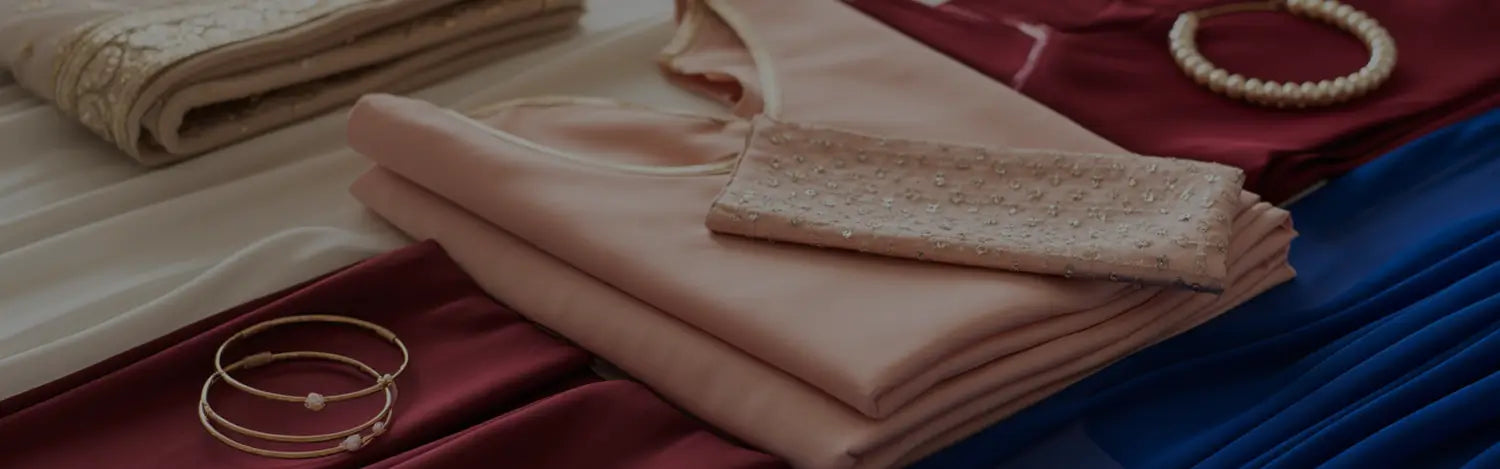

What Is Roman Silk Fabric? Feel, Composition and Care
Roman silk is a fabric trade name used by different sellers, rather than a reliable statement of fibre content. Retail listings use the name for fabrics with different specifications, including polyester-viscose blends. The name alone does not tell you whether an outfit contains natural silk, how light it will feel or whether it can be washed. Check the fabric details and care label for the particular garment before buying.
What does the Roman silk label tell you?
Start with the description of the actual outfit. A fabric name can help you find styles, but it does not replace a fibre breakdown. If natural silk content matters to your purchase, ask for confirmation for the exact style rather than interpreting the word “silk” as a purity guarantee.
Read the details for every part of a set. The kurta or gown, trousers, lining and dupatta may use different materials. A product described as a Roman silk set need not have the same fabric in every piece.
How to compare feel, sheen and drape
Look at the finished garment as well as its fabric name. A wide, flared hem creates a different silhouette from a straight kurta. Lining, embroidery and the amount of fabric used also change the weight and movement of an outfit.
Use close-up photographs to compare surface texture and full-length views to judge the silhouette. A movement video can help you see how a hem falls while walking. Photographs cannot confirm softness, breathability or fibre content, so ask about those details if they are important to you.
A Roman silk label does not guarantee that an outfit will be lighter than pure silk, resist clinging or remain comfortable for a certain number of hours. Those qualities depend on the particular fabric and garment construction.
Choosing a silhouette for your occasion
Choose the shape you enjoy wearing first, then check how the garment is made. For a sharara, look at the flare, the length and where the wider section begins. For an Anarkali, consider the amount of fabric in the skirt and whether the lining supports the shape you want. A straight kurta offers a different line again.
- Fit: Compare your measurements with the size chart for that style. Do not assume a fabric name means the garment will stretch.
- Coverage: Check sleeve length, neckline, lining and dupatta details.
- Embellishment: Look at where embroidery or sequins sit, particularly near the neckline, underarms and hem.
- Event conditions: For outdoor summer functions, ask about lining and overall weight. For an evening event, consider the venue and how much movement or dancing you expect.
When comparing prices, compare the actual included pieces, stitching, lining and embellishment rather than assuming a higher price proves a particular fibre content. Check the current product listing for the price and available options.
How to care for a Roman silk outfit
Follow the care label for your finished garment. Several Hansh Couture embroidered Roman silk styles specify dry clean only. Do not substitute a cold hand wash or a delicate machine cycle for that instruction.
Before cleaning, point out embroidery, sequins and attached trims to the cleaner. If the product page and garment label disagree, ask Hansh Couture to confirm the care method before proceeding. Follow the garment-specific instructions for ironing or steaming too, rather than choosing a heat setting from the fabric name alone.
Check that an outfit is clean and completely dry before storing it. Protect embellishments from snagging against other garments, and follow any storage instructions supplied with the piece.
Roman silk, satin and Roman Simar: compare the details
Satin describes a weave associated with a smooth, lustrous surface. Roman silk is used as a market name, so the terms do not provide a like-for-like fibre comparison. Compare the actual composition, weave, finish and garment construction instead of assuming one will always drape or photograph better.
Likewise, names such as Roman silk and Roman Simar silk are not enough to establish that one garment is heavier or more structured than another. Ask for fibre composition, lining, fabric weight if available, and a close-up or movement video of each style.
Before you order
For shoppers in India and overseas, a useful final check is the same: confirm your measurements, what is included, the care instructions and any alterations needed. If the outfit is for an event, allow time for delivery and a fitting. International shoppers should also review destination availability, shipping charges and any customs or local taxes separately in the shipping policy.
You can also compare sharara sets, checking the fabric and care details of each individual design.
A finished-garment example
The Roman Silk Embroidered Anarkali Gown Set below lists a Roman silk gown, natural crepe bottoms and a heavy net dupatta, with dry-clean-only care. It illustrates why the fabric details of each piece matter. Check current colour and size availability on the product page; the Red/S option was sold out when checked on 18 October 2026.