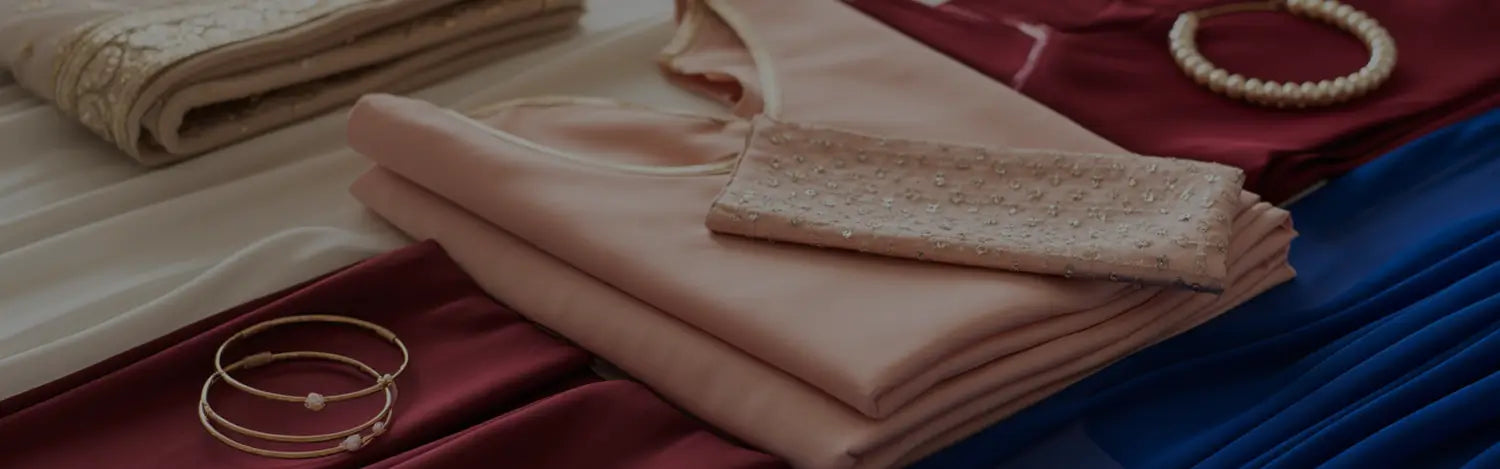

Best Fabrics for Garba Night: Stay Comfortable All Evening
Nine nights of garba is not a casual evening out. You are on your feet for 3 to 4 hours, moving continuously, surrounded by hundreds of people, often under open skies or packed indoor venues. The wrong outfit choice doesn't just make you uncomfortable — it genuinely limits how much you enjoy the night. The right fabrics for garba night, on the other hand, mean you're still dancing energetically at midnight while others have already retreated to the snack stall.
Here's what actually works, what to skip, and how to make smart choices depending on your body type and budget.
Why Fabric Choice Matters More Than Embellishment
Most women spend hours deciding between mirror work and gota patti, between a traditional Gujarati chaniya choli or a contemporary lehenga set. Very few think about the base fabric first. That's the common mistake here.
Embellishments are visual. Fabric is physical. A beautiful lehenga in the wrong material will feel like wearing a furnace after 45 minutes of continuous movement. The fabric determines how much heat your body retains, how freely your legs move, and whether the skirt creates the satisfying flare when you spin.
Garba demands a full range of motion — arms up, waist twisting, feet moving in fast rhythmic steps. Your fabric needs to move with you, not against you. For a deeper look at how different weaves and materials behave in different climates and occasions, our Indian ethnic wear fabric guide covers the full breakdown across categories.
The Best Breathable Fabrics for Garba
Rayon
Rayon is the undisputed winner for garba nights. It's plant-derived, extremely lightweight, and has a natural drape that creates beautiful circular movement. A rayon chaniya choli in a circular cut of 3 to 4 metres sits flat during footwork and opens up dramatically during spins — exactly what the dance calls for.
Most women find that rayon keeps them noticeably cooler than any other synthetic option, even when the venue is packed. It also holds block prints and bandhani patterns exceptionally well, which makes it ideal for the traditional Gujarati aesthetic without sacrificing comfort.
Cotton and Cotton Blends
Pure cotton is the most breathable option available, full stop. It absorbs sweat, allows airflow, and doesn't cling. The slight drawback is that cotton wrinkles after extended wear. A cotton-modal blend or cotton-rayon blend solves this — you get 80% of the breathability with better drape and wrinkle resistance.
For outdoor garba in Surat, Ahmedabad, or Vadodara where October evenings can still touch 28 to 30 degrees Celsius, cotton is genuinely the safest choice.
Georgette
Georgette sits between breathable and dressy in a very practical way. It's lighter than silk, has enough weight to flare nicely, and the slight texture of the fabric means it doesn't stick to your skin the way flat polyester does. Faux georgette (polyester-based) is more affordable but slightly less breathable than pure georgette — worth knowing if you're choosing between the two at a similar price point.
Chanderi
Chanderi is a semi-transparent fabric woven in Madhya Pradesh that's been popular in Western India for decades. It's sheer, lightweight, and has a subtle luminosity under stage lighting and string lights that makes it gorgeous for evening garba events. Pair it with a well-fitted blouse and a cotton lining for the skirt, and you've got a traditional look that breathes well through the evening.
| Fabric | Breathability | Best For | Budget Range |
|---|---|---|---|
| Rayon | Excellent | All-night dancing, outdoor venues | Under Rs.2000 |
| Cotton blend | Excellent | Warm outdoor garba, traditional look | Under Rs.2000 |
| Georgette | Good | Indoor events, dressy look | Rs.2000 to Rs.5000 |
| Chanderi | Good | Evening events, traditional styling | Rs.2000 to Rs.5000 |
| Pure silk | Poor for dancing | Sitting, cultural viewing events | Above Rs.5000 |
Fabrics to Avoid on Garba Night
Silk is beautiful. Save it for the wedding reception. Pure silk — whether Banarasi, Kanjeevaram weave, or plain katan — does not breathe during physical activity. It traps heat close to the body and becomes uncomfortable very quickly once you start moving.
Velvet is a firm no. It looks rich under photography lighting, but velvet is essentially a pile fabric that holds heat aggressively. Wearing velvet for garba is like wearing a winter coat in October.
Heavy polyester blends are the sneaky trap. They look like georgette or chiffon in photographs, they're priced attractively, and they photograph well. The problem is that polyester has almost zero moisture absorption — perspiration stays on your skin instead of being wicked away. After 30 minutes of dancing you'll feel the difference sharply.
Fully embroidered skirts with dense zardozi work or heavy sequin coverage across the entire surface add 800 grams to 1.2 kilograms to your lehenga. That's real weight on your waist and legs over a 3-hour event. A border-heavy design with a clean fabric body is always smarter for garba.
Choosing the Right Silhouette in the Right Fabric
Fabric and cut work together. A gorgeous fabric in the wrong silhouette still fails you on the dance floor.
For garba specifically, a circular or double-circle lehenga skirt of at least 3 metres gives you the flare that makes every spin visually satisfying and physically easier. A straight or A-line cut restricts leg movement during fast-paced steps.
- Petite frames: Lightweight rayon lehengas in solid or small-print fabrics elongate the silhouette. Avoid very wide palazzo-style garba skirts — they overwhelm a smaller frame.
- Pear-shaped body types: Georgette or rayon in a circular cut naturally skims over the hips without clinging. A fitted choli with a flared skirt is the ideal combination.
- Apple-shaped body types: Chanderi or rayon with an empire-waist choli and a voluminous circular skirt creates balance. Avoid clingy fabrics anywhere around the midsection.
- Hourglass frames: Almost any lightweight fabric works. A fitted rayon chaniya choli that highlights the waist and a 4-metre circular skirt makes the most of the proportions.
If you want ready-to-wear options that already factor in these proportions, the lehenga collection at Hansh Couture has fully stitched options starting at Rs.999 with free pan-India shipping.
Practical Styling Tips for Garba Night Comfort
The fabric is the foundation, but a few additional choices determine how comfortable your full evening is.
Inner lining matters. Even if your skirt fabric is breathable, a thick polyester lining underneath cancels out all of that. Ask specifically for a cotton or cotton-blend lining when purchasing. Most women never think to check this until they've already had one uncomfortable garba night.
Dupatta management is real. A floaty georgette dupatta pinned at the shoulder with 2 to 3 safety pins stays out of your hands and out of your footwork. An unmanaged dupatta around the wrists during garba is a hazard and a distraction.
Blouse fabric matters as much as skirt fabric. Your blouse is closest to your core body heat. A cotton or rayon blouse backing with a decorative outer layer keeps the most active part of your body coolest.
For a printed garba-ready look that doesn't require separate styling decisions, the printed lehenga sets from Hansh Couture come coordinated and ready to wear, which removes the guesswork entirely.
Footwear also connects to fabric weight. A lighter lehenga in rayon or cotton lets you wear mojris or flats without feeling weighed down. A heavier lehenga in silk or velvet becomes even more tiring when paired with anything other than very flat footwear.