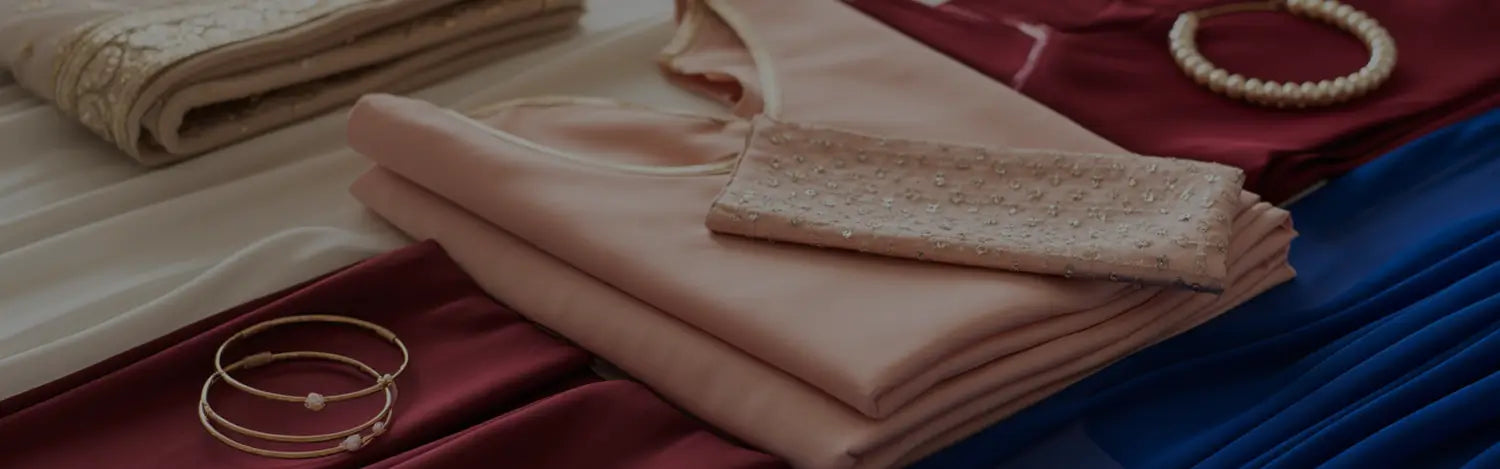

Bridesmaids Sharara: How to Coordinate Without Matching
Here's something that happens at almost every Indian wedding — the bridesmaids are asked to wear the same outfit, same colour, same everything. And somewhere between the mehndi and the pheras, at least two of them are visibly uncomfortable, one hasn't eaten because the waist is too tight, and another is quietly drowning in a style that just isn't her. There's a better way to do this. You can have a group that looks completely put-together without dressing them like they're in a school play.
The bridesmaids sharara has become one of the most popular choices for Indian wedding squads, and for good reason. It's festive, it photographs beautifully, and it works across body types far better than a lehenga does. But coordinating them well takes a little more thought than just picking one colour and sending everyone a link.
Same Colour, Different Silhouettes
This is the approach that works almost every single time. You pick one colour — say, a warm dusty rose — and then let each bridesmaid wear a sharara style that suits her own body best. One wears a wide-legged sharara with a fitted short kurti. Another goes with a flared sharara paired with a longer anarkali top. A third picks a straight-cut sharara with a cape-style blouse.
The common mistake here is thinking that matching means identical. It doesn't. What actually creates that cohesive look in photos is colour consistency, not silhouette sameness.
Which Sharara Silhouette Works for Which Body Type
| Body Type | Best Sharara Style | Top to Pair |
|---|---|---|
| Petite (under 5'2") | Narrow-flare sharara | Short kurti with V-neck |
| Pear shape | Wide palazzo-cut sharara | Fitted top with embroidery at neckline |
| Apple shape | Straight-cut sharara | Long anarkali or cape top |
| Hourglass | Classic flared sharara | Cropped blouse or fitted kurta |
| Tall and slender | Heavy embellished sharara | Mid-length kurta with zardozi work |
When you brief your bridesmaids this way, each person gets to wear something that genuinely flatters her, and the group still looks unified. It's a small shift in thinking that makes a massive difference on the wedding day.
Same Fabric, Different Colours
The second approach works especially well for families that want a little more visual variety in the wedding photos. Instead of locking everyone into one colour, you pick one fabric — georgette, for example — and let each bridesmaid choose her own shade within a defined palette.
A palette could be: blush pink, mauve, and dusty lilac. Or terracotta, burnt orange, and gold. All three colours feel like they belong together, but no two people are wearing the same thing. The fabric ensures the texture, weight, and drape all look consistent in photos, even when the colours differ.
Most women find that this approach is also much easier to agree on within a group. There's less argument over who has to wear a colour that doesn't suit her skin tone, because each person picks from options that work for her.
Fabrics That Coordinate Well Across Multiple Colours
- Georgette: Lightweight, flows beautifully in motion, and holds colour saturation well across a wide range of shades
- Organza: Adds a slight sheen that photographs well, great for evening functions from mehndi to reception
- Viscose crepe: Falls cleanly, excellent for daytime functions like haldi or sangeet where comfort matters
- Soft net: Works across embellishment levels and gives a festive texture without being heavy
If you want to explore this approach, the sharara sets come in a wide range of fabrics and colours, which makes it genuinely easy to find 4 to 6 different shades that still feel like a cohesive group.
The 3 Coordination Details That Actually Matter
Beyond colour and fabric, there are 3 specific details that tie a bridesmaid group together visually. Get these right and the group looks intentional, even if everyone is wearing something slightly different.
1. Dupatta Consistency
This is the single most underused coordination tool. If everyone wears a different outfit but carries the same dupatta colour — say, a gold tissue dupatta across all outfits — the group instantly reads as coordinated in photos. Dupatta draping doesn't even need to be identical. One person drapes it across both shoulders, another pins it to one side. It still works.
2. Embroidery Style (Not Quantity)
Mixing chikankari embroidery with heavy zardozi work across the same group looks chaotic. What actually works is keeping the embroidery style consistent while varying the coverage. Everyone has thread embroidery, for example, but the bride's closest friends have more of it, while the others have a lighter version of the same motif.
3. Neckline Agreement
You don't need to match necklines exactly, but if the group has a mix of deep V-necks, boat necks, and high necks all at once, the photographs look disorganised. Agreeing on a general neckline direction — open versus closed, for instance — is enough to maintain visual harmony.
For more guidance on how to think about outfit coordination across different wedding functions, this complete Indian wedding outfit guide covers the full picture from mehendi to reception.
How to Handle Group Ordering Without the Chaos
Group ordering for 5 or more people across different cities is genuinely complicated if you don't approach it methodically. The biggest issue isn't budget or design — it's sizing. Everyone assumes they know their size, and at least 2 people in every group are wrong.
Here's a system that works. Collect measurements for all bridesmaids first: bust, waist, hip, and height. Standard sizes in ethnic wear typically run from size 34 to 44 in ready-to-stitch formats. If your group has anyone outside that range, look specifically for full-stitched or customisable options so no one is left trying to alter a too-small outfit two days before the wedding.
Budget tiers to plan around:
- Under Rs.2,000: Solid georgette or crepe shararas with minimal embellishment, great for daytime functions like haldi
- Rs.2,000 to Rs.5,000: Embroidered sets with dupatta included, suitable for sangeet and mehndi
- Above Rs.5,000: Heavier fabric with zardozi or sequin work, reception-appropriate and photograph beautifully in low light
Hansh Couture offers free pan-India shipping, which genuinely simplifies things when your bridesmaids are in Mumbai, Delhi, and Bengaluru all at once. You can browse the co-ord sets as well if some of your bridesmaids prefer a more contemporary silhouette alongside the traditional sharara wearers in the group.
Regional Considerations Worth Knowing
What reads as "coordinated" varies a little by region, and it's worth factoring this in if your wedding guest list is mixed.
In North Indian weddings, richer colours like deep reds, emerald greens, and royal blues are common for bridesmaids. The sharara in these settings often carries heavier embellishment. South Indian weddings tend to lean toward silk fabrics and more muted or pastel tones for the bridal party. Bengali celebrations often feature brighter, bolder palettes — marigold yellow, bright orange, and deep pink — with lighter, more breathable fabrics since many functions happen outdoors.
Knowing which regional context your wedding falls into helps you guide the group toward choices that feel appropriate for the occasion, not just aesthetically pleasing on a screen.